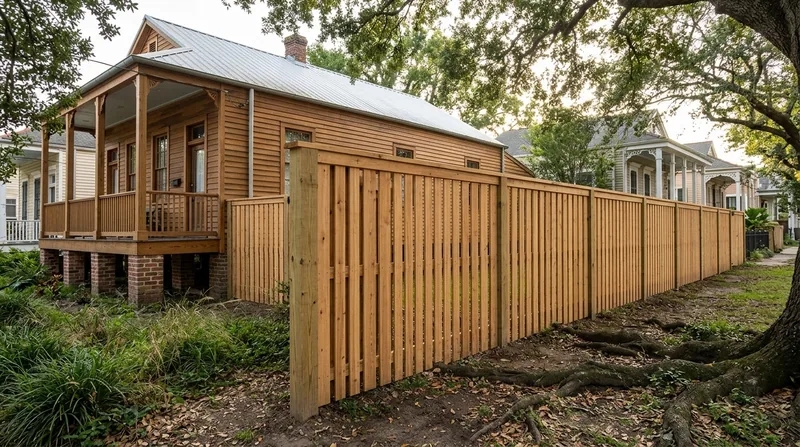




Privacy fence installation in New Orleans demands materials and methods built for the region's permanently wet ground line and the old live oak root systems that define historic neighborhoods like the Garden District and Uptown. Wood privacy fences here fight rot from the soil up, and proper installation means setting treated posts deep into deltaic clay, routing runs around mature trees, and choosing species that hold up year after year. We have installed and repaired privacy fencing since 2010, working on residential properties across New Orleans and the surrounding parishes, and we understand what fails and what lasts on this ground. Whether you are building a new fence line or replacing one that has rotted at the base, this guide walks you through the work, the costs, and what to expect from start to finish.
Why Wood Privacy Fencing Matters in New Orleans: Ground Conditions and Longevity
Wood privacy fences in New Orleans face constant moisture at the ground line, where soil stays saturated and wood breaks down faster than in drier climates. The posts, stringers, and rails that touch earth or stand in standing water are the first to fail, and a fence installed without proper drainage or depth will rot from the base up within five to eight years. Choosing the right wood species, setting posts in concrete below the active soil layer, and keeping the fence line clear of debris and standing water are the differences between a fence that lasts and one that needs replacement halfway through its service life.
- Pressure-treated pine posts resist rot better than untreated wood and are the industry standard for ground contact in wet soil.
- Cedar boards and rails offer natural rot resistance and a finished appearance but still require proper post support and drainage.
- Posts set in concrete 24 to 36 inches deep hold longer than tamped posts and prevent heaving from ground movement.
- Board-on-board and side-by-side configurations both provide privacy, and the choice depends on your aesthetic preference and wind exposure.
- Routine inspection of the base, especially after heavy rain or flooding, catches rot early and prevents expensive replacement.
Addressing moisture and ground conditions at installation time is the single largest factor in how long your privacy fence will serve.
Key info: In neighborhoods like Metairie and Chalmette, where standing water is common after rain, we route fence runs to shed water away from the post line and set posts with proper concrete collars to keep soil moisture from wicking up the wood. This detail alone can add five years to fence life in high-moisture zones.
For more on how moisture affects fence posts, see our guide to fence post repair and replacement.
How We Install Wood Privacy Fences in New Orleans: The Process from Survey to Finish
Installation starts with a clear understanding of your property line, existing utilities, and any trees or obstacles in the run. We call for a Louisiana 811 utility locate before we dig any post holes, confirming that gas, electric, water, and sewer lines are marked. Once the line is confirmed and utilities are clear, we measure, mark post positions at standard spacing (typically 6 feet on center), and begin post installation. Each post is set in concrete to the depth required by local code, and stringers are attached with galvanized hardware to prevent rust and fastener failure.
- We work from your existing property survey or the line you identify, ensuring the fence sits where you intend it to sit.
- Posts are set in concrete 24 to 36 inches deep, depending on soil conditions and frost depth, to resist heaving and rot.
- Stringers are attached with galvanized bolts and brackets to prevent rust staining and hardware failure over time.
- Boards are cut to length, spaced for privacy or aesthetics, and fastened with galvanized or stainless fasteners to match the post and stringer hardware.
- The top is capped with trim or left open, depending on your preference and local HOA or code requirements.
- We remove and haul debris, leaving the site clean and ready for use.
The entire process, from layout to finish, typically takes two to four days for a standard residential run, depending on length, terrain, and tree obstacles.
Example: A 120-foot privacy fence in the Garden District that had to be stepped (not racked) to follow grade change and routed around three mature live oak root systems took three days to install. Posts were set 3 feet deep in concrete to clear the clay, and board-on-board construction provided the privacy the homeowner wanted without blocking root zones.
Learn more about gate installation if your privacy fence includes an entry or driveway gate at gate installation and repair.
Wood Privacy Fence Installation Methods: Choosing the Right Approach
| Method | Description | Best for |
|---|---|---|
| Board-on-Board | Boards alternate on either side of the stringers, creating a solid appearance from both sides and allowing slight wind passage between boards. | Neighborhoods where both sides of the fence are visible, and you want finished appearance and privacy without a wind-load penalty. |
| Side-by-Side | Boards are installed on one side of the stringers, presenting a finished face to one direction and the stringer structure to the other. | Properties where one side is visible (a yard side) and the other faces a neighbor's fence or the property line, reducing material and cost. |
| Stepped Installation | Posts and sections are stepped down following the slope of the ground, keeping the fence level at each section and avoiding a racked (diagonal) appearance. | Sloped terrain where a level fence line is preferred and the ground changes more than 12 inches per 6-foot section. |
| Racked Installation | Posts remain vertical and evenly spaced while boards are cut at an angle to follow ground slope, creating a diagonal line along the fence face. | Gentle slopes where the visual effect of a racked fence is acceptable and the cost of stepped installation is not justified. |
| Cedar Construction | Premium western red cedar or eastern red cedar boards and posts, offering natural rot resistance and a warm finish without paint or stain. | High-visibility neighborhoods like Uptown where aesthetic quality is a priority and the homeowner is willing to invest in durability and appearance. |
Each method has a place, and the right choice depends on your terrain, budget, aesthetic goals, and how visible the fence will be from the street or neighboring properties.
Wood Privacy Fence Installation Cost in New Orleans: What to Expect
Privacy fence costs in New Orleans start at approximately $32 per linear foot for a standard pressure-treated pine installation with posts set in concrete and basic board-on-board or side-by-side construction. That figure covers materials, labor, and site cleanup for a straightforward run on level ground with clear access and no major obstacles. Several factors move the price up: tree obstacles that require routing or careful post placement, sloped terrain that demands stepped installation, premium wood like cedar, board-on-board construction instead of side-by-side, and proximity to structures that limit equipment access.
A 150-foot privacy fence on level ground in a suburban lot typically costs between $4,800 and $6,000 installed. The same footage in a historic neighborhood with mature trees, sloped terrain, and stepped installation can run $6,500 to $9,000 or more. Getting estimates from two or three contractors in your area gives you a realistic picture of local pricing and lets you compare scope, materials, and warranty. For detailed pricing on common configurations and a full breakdown of what affects cost, see our pricing overview.
Remember that the lowest bid is not always the best value. A contractor who sets posts shallowly to save labor or uses untreated lumber to cut material cost will leave you with a fence that fails in five years. Spending more upfront for proper post depth, concrete setting, and quality lumber is an investment in longevity.
Wood Privacy Fence Installation Near Me: What New Orleans Homeowners Should Know Before Hiring
Hiring the right contractor for privacy fence installation means checking insurance, understanding how fence work is regulated in Louisiana, getting multiple estimates, and confirming that any work will meet local code and HOA requirements. Louisiana issues no state license specific to fence installation, but residential fence work valued at $7,500 or more falls under the state's home improvement contracting rules, and work at $50,000 or more requires a licensed general contractor. For most residential privacy fence jobs, the threshold is below $7,500, so no state registration is required, but your city or parish may have local permitting rules and height or setback restrictions. We are fully insured with general liability and workers' compensation coverage, and we can provide a certificate of insurance on request.
- Ask the contractor for proof of insurance (general liability and workers' compensation) and verify the coverage limits are adequate for the scope.
- Confirm with your local building department whether a permit is required for your property and what height, setback, and material rules apply in your neighborhood.
- If you live in an HOA community, check the architectural guidelines for fence height, material, color, and style before signing a contract with any contractor.
- Get at least two written estimates that itemize materials, labor, post depth, concrete setting, and the warranty or guarantee on workmanship.
- Check references and ask contractors about their experience with properties similar to yours, especially if trees or sloped terrain are factors.
- Confirm that the contractor will call for a Louisiana 811 utility locate before digging any post holes, as this is required by law.
A trustworthy contractor will answer these questions directly, provide documentation, and take time to understand your property and your goals before quoting a price.
Ready to move forward? Contact us for a free estimate, or call (504) 285-7187 to discuss your project with one of our installation specialists.
Wood & Privacy Fence Installation in New Orleans: Pricing Guide
| Service | Price | Details |
|---|---|---|
| Standard pressure-treated pine privacy fence | Starting at $32/ft | Posts set 24-36 inches deep in concrete, galvanized hardware, board-on-board or side-by-side, level ground, clear access |
| Cedar privacy fence | Starting at $48/ft | Premium western or eastern red cedar boards and posts, natural rot resistance, finished appearance, standard installation depth and concrete setting |
| Stepped or racked installation on sloped terrain | Add $8-$15/ft | Additional labor and materials for grade changes exceeding 12 inches per section, stepped configuration adds cost and complexity |
| Tree routing and obstacle navigation | Add $150-$400 per obstacle | Custom post placement around mature root systems, careful hand digging, rerouting fence line to preserve trees and meet property line |
| Estimate and site visit | Free | Response within 24 hours, no obligation to book, phone estimate available at (504) 285-7187 for straightforward projects |
Indicative pricing, the exact cost depends on square footage, finish, and site access. Free personalized estimate within 24h at (504) 285-7187.


